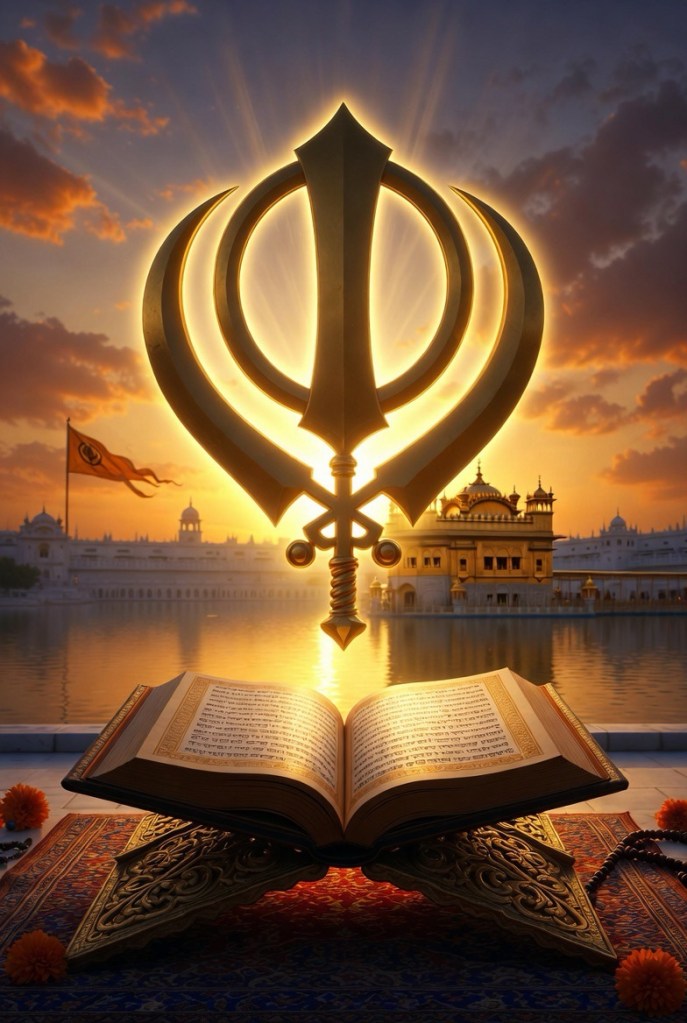
Sikhism was founded in the Punjab region of South Asia in the late 15th century by Guru Nanak Dev Ji. Born into a world divided by Hindu and Muslim conflict, Guru Nanak proclaimed a message of radical unity: “There is no Hindu, there is no Muslim.” Over the following two centuries, nine successive Gurus developed the faith’s theology, institutions, and community.
At the core of Sikhism is belief in one formless, eternal God (Waheguru), devotion through meditation on God’s name (Naam Japna), honest work (Kirat Karni), and sharing with others (Vand Chakna). The Guru Granth Sahib, the sacred scripture compiled by the tenth Guru and considered the eternal living Guru, contains hymns composed by the Sikh Gurus and saints from other traditions.
Sikhs are recognizable by the Five Ks uncut hair (Kesh), a comb (Kangha), a steel bracelet (Kara), a wooden comb (Kanga), and an undergarment (Kachera) symbols of faith and identity. The community kitchen (Langar), where food is served freely to all regardless of caste or creed, embodies the Sikh principle of equality and service.
With roughly 25–30 million followers, mostly in Punjab, India, and diaspora communities worldwide, Sikhism is the world’s fifth-largest religion.